Vāgbhaṭa Āchārya and Kaśyapa Maharṣi — Their Connection in Ayurveda

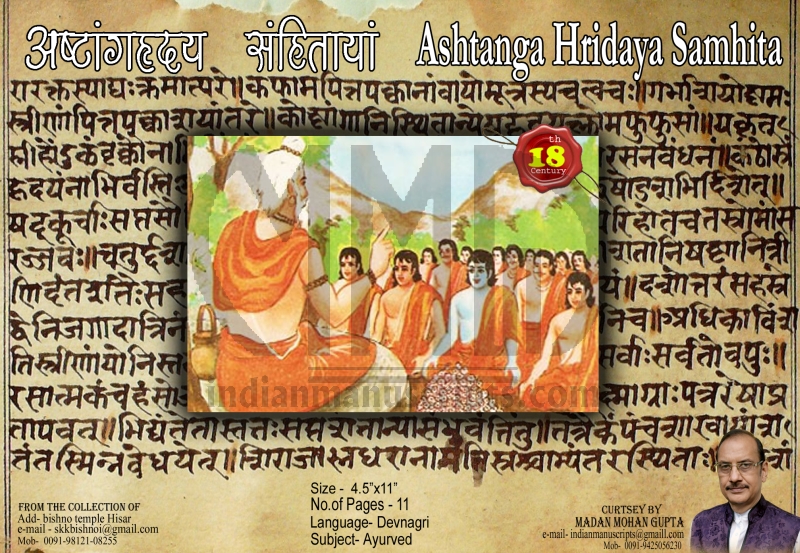


Ayurveda, as a continuous scientific tradition, grows through teacher–student lineages and textual inheritance. In this lineage, Kaśyapa Maharṣi and Vāgbhaṭa Āchārya share a deep intellectual and philosophical connection, even though they lived in different historical periods. Kaśyapa belongs to the early classical era of Ayurveda, whereas Vāgbhaṭa lived much later, during the post-classical to early medieval period. Still, their relationship is preserved through textual influence, shared concepts, and clinical approaches.
1. Kaśyapa Maharṣi: The Early Foundation
Kaśyapa Maharṣi is one of the ancient seers of Ayurveda, credited with the Kaśyapa Saṃhitā, a major classical text known especially for:
-
Kaumāra-bhṛtya (pediatrics)
-
Stree-roga (gynecology)
-
Prasooti tantra (obstetrics)
-
Dietetics and preventive medicine
Kaśyapa emphasizes nurturing life from conception, proper balasamskara, immunity building, and daily/seasonal regimens. His work is highly practical, focusing on protecting the child and mother, and maintaining balance in early life.
2. Vāgbhaṭa Āchārya: The Great Integrator
Vāgbhaṭa is known for the Aṣṭāṅga Hṛdaya and Aṣṭāṅga Saṅgraha, texts that summarize the entire Ayurvedic knowledge available up to his time.
He synthesizes ideas from:
-
Charaka
-
Suśruta
-
Kaśyapa
-
Other contemporary scholars
His writings are highly organized, poetic, and easy for students and physicians to apply.
3. The Connection Between Vāgbhaṭa and Kaśyapa Maharṣi
(A) Textual Influence
Vāgbhaṭa cites and echoes many concepts originally presented in Kaśyapa Saṃhitā.
Some of these include:
-
Development of the fetus
-
Importance of garbhini paricharya (care during pregnancy)
-
Role of stanya (breast milk) in immunity and development
-
Pediatric diseases and digestive issues
-
Use of gentle herbs for infants and pregnant women
Though Vāgbhaṭa does not always directly mention Kaśyapa by name, he incorporates the essence of Kaśyapa’s teachings and refines them in a more systematic format.
(B) Philosophical Continuity
Kaśyapa’s approach focuses on preservation of health and development of strong immunity from early life.
Vāgbhaṭa continues this emphasis through:
-
Dincharya (daily routine)
-
Ritucharya (seasonal wellness)
-
Rasayana chikitsa (rejuvenation)
All these reflect Kaśyapa’s influence on ensuring long-term physical and psychological stability.
(C) Clinical Practices
Many pediatric treatment methods described by Vāgbhaṭa—such as:
-
Handling colic
-
Teething issues
-
Worm infestations
-
Childhood fevers
—are aligned with Kaśyapa’s earlier descriptions.
Kaśyapa’s text is more detailed in pediatrics, but Vāgbhaṭa adopts the practical portions and condenses them for easy clinical use.
(D) Lineage Influence
While we do not have clear evidence that Vāgbhaṭa was directly in Kaśyapa’s disciple lineage, the textual style shows:
-
Reverence for the earlier sages (pūrva-acharyas)
-
Absorption of Kaśyapa’s core ideas
-
Continuation of Kaśyapa’s focus on child and maternal health
Thus, Vāgbhaṭa stands as a successor who preserved and repackaged Kaśyapa’s legacy for later generations.
4. Understanding Their Connection in Modern Terms
| Ancient Concept | Modern Understanding | Connection |
|---|---|---|
| Garbhini paricharya | Maternal nutrition & prenatal care | Kaśyapa → Vāgbhaṭa elaborates and systematizes |
| Stanya & balasamskara | Immunology & neonatal care | Kaśyapa’s foundation reflected in Vāgbhaṭa |
| Child development stages | Pediatrics & developmental milestones | Both authors give guidelines still clinically relevant |
| Preventive care | Public health | Kaśyapa’s preventive emphasis refined by Vāgbhaṭa |
| Gentle pediatric medicine | Pediatric pharmacology | Shared emphasis on safe, mild therapies |
In modern terms, Kaśyapa is like the original researcher, and Vāgbhaṭa is the great editor and textbook writer who brings earlier research into a unified, easy-to-understand form.
5. Summary
-
Kaśyapa Maharṣi is an early Ayurvedic seer specializing in pediatrics and women’s health.
-
Vāgbhaṭa, who came centuries later, built upon and integrated Kaśyapa’s teachings.
-
Their connection is not of direct personal association but a deep scholarly and philosophical lineage.
-
Vāgbhaṭa ensured that Kaśyapa’s pediatric and maternal-care principles would continue in mainstream Ayurveda.

No comments:
Post a Comment
If you have any doubts on about Ayurveda treatments about different diseases, different Panchakarma Procedure, Home Remedy, Alternative Medicine, Traditional medicine,Folk medicine,Medicinal Plants, Special diets, Ayurveda medicine ,Complementary medicine LET ME KNOW